DANDELION – POOR MAN’S GINSENG
Christopher Nyerges
[Nyerges is the author of “Guide to Wild Foods and Useful Plants,” “Foraging Wild Edible Plants of North America,” “Urban Survival Guide,” and other books. Information about his books and classes is available from www.SchoolofSelf-Reliance.com]
PHOTOS, by Christopher Nyerges unless otherwise indicated.
Now is the time when many ordinary city folks are beginning to panic. All throughout Southern California, and much of North America, an “enemy” is appearing on lawns. What enemy? Dandelions! Dandelion has long been featured prominently in ads for garden herbicides, which are guaranteed to keep the weeds away, which should be translated as “guaranteed to keep your soil toxic.”
It turns out dandelion is more nutritious than many of our common vegetables. This has been documented for decades by the USDA in such references as “Composition of Foods.”
According to the USDA, 100 grams of raw dandelion leaves yielded 14,000 international units of vitamin A (hey, that’s a lot!), 35 milligrams of vitamin C, 187 milligrams of calcium, 76 milligrams of sodium, and 397 milligrams of potassium.
According to a study published in 1990 in the Berkeley Wellness Letter, dandelion greens are a rich source of beta carotene. (Beta carotene is one of a large group of substances called carotenoids.) It used to be thought that the benefits of beta carotene were due to its conversion to vitamin A, but research suggests that beta carotene itself is the more potent protector against cancer.
Numerous animal studies have suggested that beta carotene can defend against tumors and enhance the immune system. At least 70 studies on humans concluded that humans who don’t eat enough fruits and vegetables rich in carotenoids have an increased risk of cancer, and lung cancer in particular.
One large study, presented at the London conference by Dr. George Comstock of Johns Hopkins University, found that individuals with low levels of beta carotene in the blood had a far greater risk of developing lung cancer as well as melanoma, a lethal form of skin cancer.
Interestingly, in the published report, there was an accompanying chart listing dandelion greens as the richest source of beta carotene: one cup of the cooked dandelion greens yields 8.4 milligrams. One large carrot contains 6.6 milligrams of beta carotene.
For the record, the other top beta carotene sources were one medium sweet potato [5.9 milligrams], ¾ cup cooked watercress [5.6 milligrams], ¾ cup cooked kale [5.3 milligrams], ½ cup cooked spinach [4.9 milligrams], and ½ medium mango [2.9 milligrams]. Since some beta carotene is destroyed by cooking (the longer you cook, the more is destroyed), the beta carotene content of dandelion and other foods would be even higher when consumed raw.
Herbalists such as Gene Matlock and Michael Moore believe that dandelion is the perfect herb for coping with anemia. The leaves eaten fresh purge the uric acid from the blood and are said to be excellent for liver ailments. Dandelion is a mild diuretic and a mild laxative. The fresh leaves are used by herbalists for skin diseases, diabetes, pancreas and spleen problems, and fever. The root is a tonic, mild laxative, and diuretic. Dandelion roots were included in the United States Pharmacopoeia from 1831 to 1926.
TESTIMONIAL
In July 1998, Vonda White wrote me the following from the California Institute for Women:
“One morning in May of this year, I awoke with what I realized was a bladder infection. I have long been accustomed to seeking herbal remedies when ill, so I looked into what was readily available to me. One of the most commonly found herbs growing here is dandelion—a specific remedy for such problems as mine. On my way into the dining room for breakfast, I saw some nice dandelion plants growing at the edge of the sidewalk, and I picked and ate a few tender leaves. The leaves were mildly bitter but tasted very good to me. Growing next to the dandelion was some young prickly lettuce, which I also ate. On my way out of the dining room, I picked and ate more of both. I did not notice any immediate or miraculous improvement in my condition through the day, but I continued to drink extra water. On my way to dinner that evening, I picked and ate more dandelion and prickly lettuce. The miracle was that the next morning there was no more problem.”
Due to dandelion’s richness in vitamins and minerals, the plant is sometimes called poor man’s ginseng. It is readily available around the world, is far cheaper than ginseng, and will likely improve your health as much as ginseng—especially if you’re out on fields and lawns collecting it yourself.
IDENTIFYING DANDELION
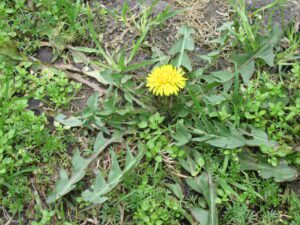
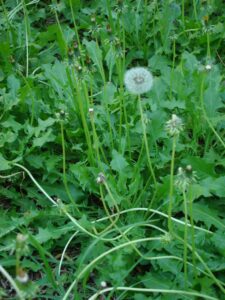
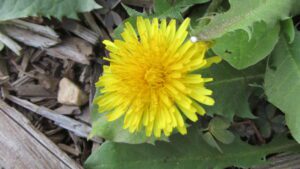
Dandelion (Taraxacum officinale) is commonly found in lawns and fields, first appearing as a ground-hugging basal rosette of leaves reaching about nine inches in diameter. The plant is most often noticed by the bright yellow flowers which appear on the end of a leafless stalk. As the flowers mature, they develop into a ball of fuzzy seeds, the seed clusters which children love to blow and make a wish.
The word dandelion is derived from the French dent de lion, which translates to lion’s tooth. This refers to the configuration of the jagged-edged leaves, which are pinnately divided into sharp lobes. The low-lying leaves often become prostrate and are thus able to hide among the blades and stems of grass. The leaves exude a milky juice when cut. The brown taproot resembles a small, slender carrot, but tan in color. It may get knotty as it gets older, and is generally from three to five inches in length. Today, dandelions are found throughout the world; botanists generally agree that this plant is native to Greece. It has established itself all over the United States, and can be found on virtually any lawn, field, or similar area that has fairly consistent moisture.
HOW TO EAT DANDELIONS
The young-to-early mature leaves are edible raw in salads or sandwiches. The older leaves become increasingly bitter and need to be cooked and prepared in much the same way one handles greens. Cooked dandelion leaves are similar to spinach.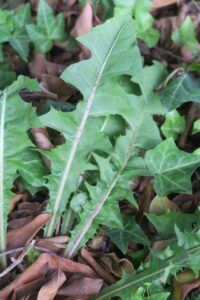
The crown (the one-inch section between the lower leaves and the upper root section) can be eaten as a separate hot vegetable or added to mixed vegetable dishes. It should be steamed or boiled if too bitter.
The roots are commonly roasted to make a good-tasting noncaffeine coffee. To do this, you first dig up the largest roots available and thoroughly wash until free of dirt. Dry them (in the sun or oven at low heat), then grind them in a grain or coffee grinder, mortar and pestle, or electric grinder. Roast in 225°F oven until brown, then percolate the same as with coffee grounds. Drink plain or try adding raw cream and/or honey. Unseasoned, it tastes something between coffee and Postum (a popular commercial cereal beverage made of barley, wheat, and molasses).
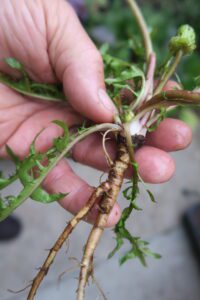
The cleaned roots can also be cooked (steamed or boiled if older and bitter) and eaten (something like parsnips).
The fresh, dew-covered flowers, carefully gathered in the early morning, are fermented to make the unique-tasting dandelion wine.
SIDEBAR
“DANDELION CELEBRATION”

When I think of dandelions, I always think of Peter Gail, author of Dandelion Celebration, 151 pages of every
thing you’d ever want to know about dandelions. Peter was interested in wild plants since his childhood when necessity forced his family to utilize goosefoot and other wild greens for meals. eventually, he earned a Phd in plant ecology at Rutgers university. In the 1970s, Peter Gail worked with Euell Gibbons in developing the national Wilderness Survival training camps for the Boy Scouts national council in New Jersey. Gail and Gibbons developed a wild food foraging course for Rutgers, and Gail was often Euell Gibbons’s backup lecturer. Gail lists the many medicinal uses of dandelion, such as a cure for liver diseases, a tonic, a way to dissolve kidney stones, a skin cleanser, a high blood pressure preventive measure, an aid in bowel functioning, a prevention or cure for anemia, and an assistant in controlling diabetes. Still, most folks think of dandelions as food, not medicine, so Gail provides us with about 600 recipes he has collected over the entire United States. Some of the recipes are Amish, some are his own, and many are from his travels throughout the United States.