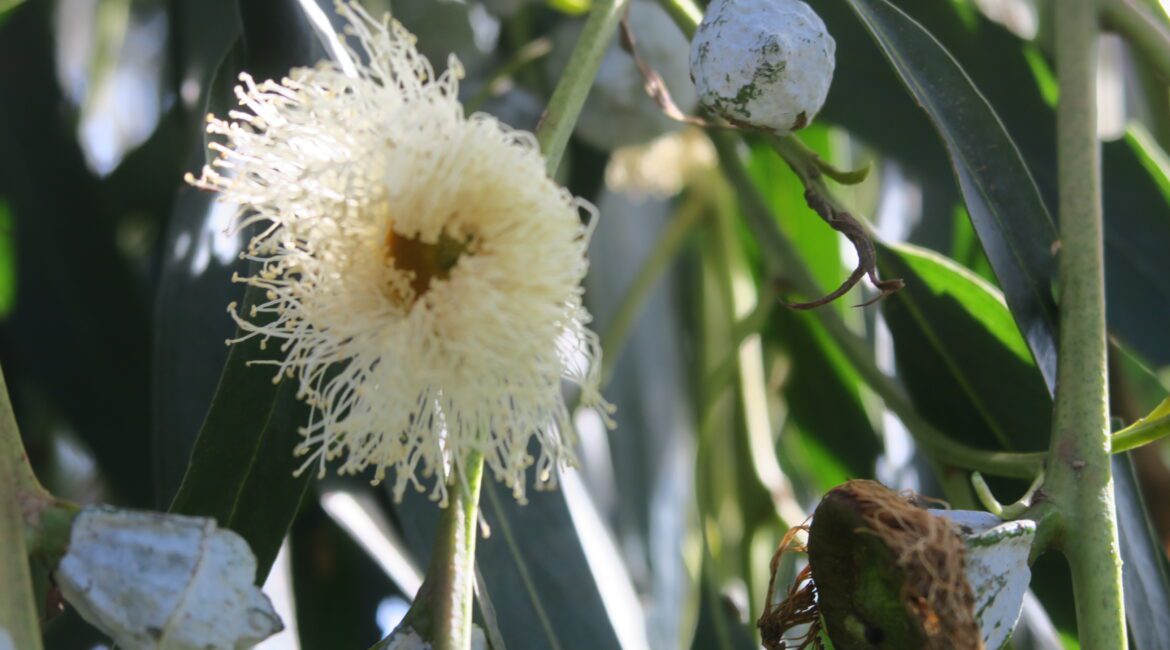
ARE EUCALYPTUS A DESIRABLE SPECIES IN THE CALIFORNIA LANDSCAPE?
Christopher Nyerges
[Nyerges is the author of “Guide to Wild Foods,” “Foraging California,” “How to Survive Anywhere,” and other books. He can be reached at Box 41834, Eagle Rock, CA 90041, or www.SchoolofSelf-Reliance.com.]
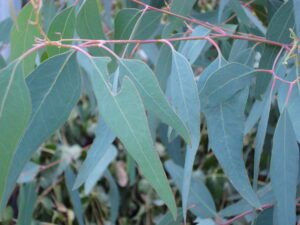
Eucalyptus is a tree with a mixed reputation. This stately tree is renown for the “forest effect” due to the high transpiration rate of its leaves. According to one report, “In Sydney, a large gum tree [eucalyptus] transpires up to 200 litres of water a day. A well-maintained garden in Sydney will transpire nearly twice the volume of water as the total rainfall.”
The tree was included in my Guide to Wild Foods book since it was so useful in its native Australia by the Aboriginees: the leaves for various medicines (mostly upper bronchial issues), the bark for infections and many other uses, and even the little psyllid bugs can be harvested and eaten like a backwoods sugar. And the honey produced from eucalyptus flowers is a dark almost-medicinal honey.
But is it good for the California environment to remove the eucalyptus trees and replace them with natives?
In order to fully grasp the effects of eucalypti on the environment, let’s look at its effect in other parts of the world.
Eucalyptus is a fast-growing tree. When you cut them down, they will sprout right back up again. Because of this, there have been major plantations in various countries throughout the world from Europe to China to Africa in order to supply the wood for lumber, paper products, and firewood. If the eucalyptus trees are planted in non-agricultural areas where nothing else will grow, they survive quite well. A eucalyptus tree in a plantation can be cut as little as every four years.
Around the time that the U.S. was experiencing long gas lines during the 1970s ”energy crisis,” many countries around the world discovered that the eucalyptus tree seemed like a miracle tree. It grew easily anywhere, and could be regularly harvested for fuel wood, building materials, and pulp for paper. It was also a financial boom to the public and private businesses in various countries who grew these plantations. Today, eucalyptus is the number one tree planted in plantations around the world. With so many undeniable benefits, what could go wrong?
Over the last 30 to 40 years, countless business, governmental, and academic studies have been done to weigh the pros and cons of the largescale use of the eucalyptus tree.
There were very real worries about deforestation and desertification that began in the 1980s. Eucalyptus trees, with its obvious economic benefits, were planted in ever-greater numbers. Today we can analyze the ecological effects of over 30 years of eucalyptus plantations.
For starters, there have actually been riots in protest of new eucalyptus plantings. Really, riots? In Northeast Thailand, most of the native forests had been completely logged by private companies, which affected the water, and forced local people to relocate. The Thai government, along with the World Bank, planted eucalyptus trees as a cash crop. However, it was noted that some results of the thousands of eucalyptus trees planted included lowering the water table for villages, drying up local wells, and making the farmable land less valuable due to the allelopathic effects of the eucalyptus leaves. When the Thai government began to grow even more eucalyptus plantations, villagers in the Tung Kula Ronghai section of Thailand, held meetings, marches, rallies, and they also blocked roads, burned eucalyptus nurseries, ripped out eucalyptus seedlings, and chopped down eucalyptus trees, and planted fruit trees.
Because the eucalyptus tree is such a great transpirer, it follows that it generally consumes far more water than other native or non-native trees. In fact, one of the stated reasons that eucalyptus is planted in certain countries is to dry up swamps and wet areas, either for development or because the wet area was believed to be a source of malaria. The deep roots of eucalyptus, and their extensive network of small surface roots, has been noted to extend deep to the water table.
Although a eucalyptus plantation does very well in dry areas where nothing else is growing, in areas as diverse as China, Ethiopia, Vietnam, etc, local villagers of these diverse places have noted that their water wells run dry. In fact, this seems to be one of the main objections to eucalyptus plantations: it dries up the local sources since it generally consumes more water than is received by rain in any given area, which then means there is far less water for agricultural crops and orchards.
In studies done to determine if the leaf drop from eucalyptus is “allelopathic” (exuding soil toxins), various plants grown in a mixture of eucalyptus mulch and soil have exhibited a germination rate as low as 3%, compared to normal rates of germination with an oak mulch.
Another argument against the eucalyptus plantations is that there is a great depletion of soil nutrients. In general, eucapytus take up more nutrients (and water) from the soil than other native or non-native trees because they are fast-growing. And, in theory, if all the leafy matter was left on the ground (as opposed to cleaning it up), those nutrients would degrade and enrich the soil. But unfortunately, eucalyptus mulch takes a very long time to be degraded by bacteria and fungus due to its oils, and so in actual practice, the soils around eucalyptus tend to be very desert-like due to the unavailability of nutrients. [Source: The Effect of Eucalyptus and Oak Leaf Extract on California Native Plants, Kam Watson, UC Berkley]
This effect results in the lack of biodiversity and understory that is commonly observed under and around eucalyptus trees, in stark contrast to native forests.
One study was also done with soil under the eucalyptus trees, along with a soil sample not influenced by eucalyptus. Soil samples from under eucalyptus trees proved to be less able to absorb water. This meant that though eucalyptus trees have been planted in areas to reduce runoff and flooding, this result is not usually successful because of the effect of the tree’s oil on the soil.
These same results have been documented in eucalyptus plantations in China, Kenya, Ethiopia, Vietnam, and other sites.
Kenya Forest Service has published guidelines, basically aimed at promoting eucalyptus plantations in the country, called “A Guide to On-Farm Eucalyptus Growing in Kenya”, December 2009.
They advise not growing eucalyptus in wetlands and marshy areas, and riparian areas. They advise not growing eucalyptus closer than 30 meters from rivers, and ideally 50 meters, so that the trees do not adversely interfere with the water source.
They add that other areas where eucalyptus should not be planted include around lakes, ponds, swamps, estuary and any other body of standing water. They advice that eucalyptus not be planted closer than 50 meters to farm lands, and other measures. In other words, even those who are pro-eucalyptus recognize the adverse effects of eucalyptus on the environment, and offer ways to minimize those effects.